Pixar at 40 – Insider on ‘insane’ near miss, Toy Story 5 and AI challenges | Films | Entertainment

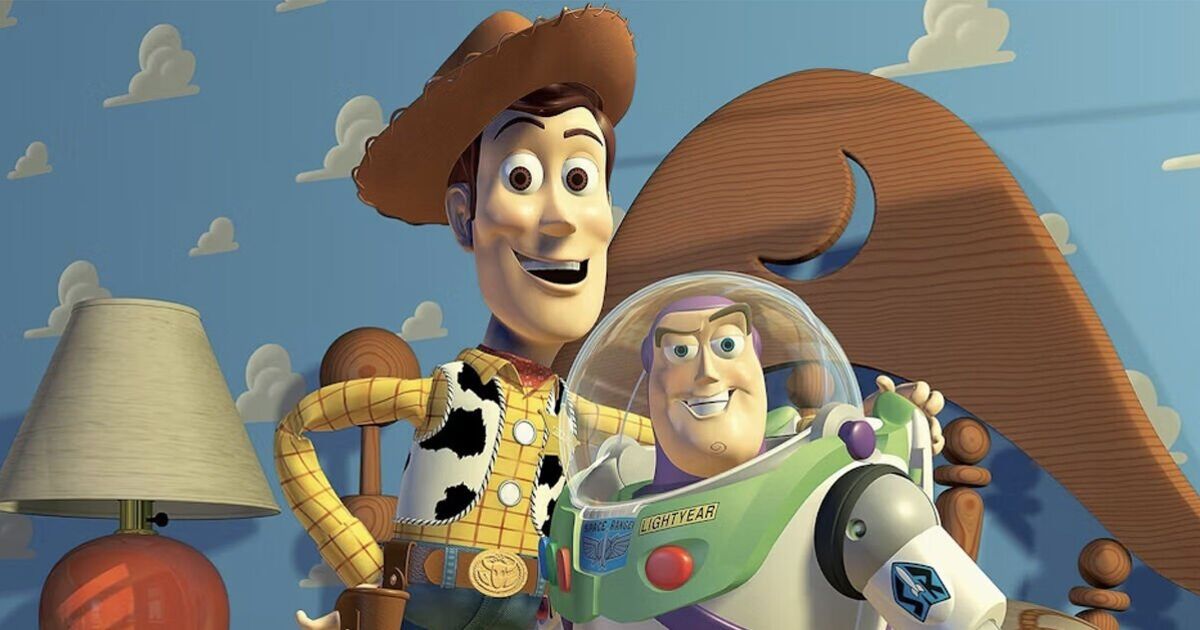
Woody and Buzz in 1995’s Toy Story (Image: Pixar)
Reclining on a larger-than-life red chair next to a pile of oversized books, I feel like one of the sentient toys come to life in the phenomenally successful Toy Story films. The eye-catching recreated set from Sunny Side Daycare, which featured in the franchise’s third instalment, is one of 13 Pixar universes on show in London for a major new exhibition celebrating the animation studio’s 40th anniversary.
Fans and families can get lost in a tour of the most famous locations from Monsters Inc., Cars, Finding Nemo, Inside Out, and more, featuring sounds, smells, music and life-sized familiar figurines that are great for taking selfies. And walking around, it doesn’t take long for my own memories of Toy Story to come flooding back – I was just four years old when the first-ever CGI-animated feature film was released in 1995. My parents and I were so enamoured by the unforgettable characters and heartfelt, humorous storytelling that we ended up seeing it three times on the big screen.
It’s for this reason that The Mundo Pixar Experience is the perfect place to meet the studio’s Creative Director of Franchise, Jay Ward, the genius behind many of its immersive adventures since 1998. The cheery 56-year-old Californian began his career on Monsters Inc and was an art coordinator on the Cars franchise. Today, his job entails overseeing post-film creative projects like this one to help fans across generations engage with the franchise for years to come.

Monsters Inc’s Sully and Mike at Mundo Pixar Experience (Image: Aaron Perez Bauer-Griffin)
Now, underneath a giant Lots-O’-Huggin’ Bear (Toy Story 3’s antagonist), Ward explains why Pixar’s formula proved its critics wrong – including future owner Disney. In 1991, a cash-stripped Pixar signed an agreement with Disney to co-produce three feature-length films including the first Toy Story, about a set of toys that come to life when humans are not around.
Disney would retain the rights and creative control over the film in return for giving Pixar access to its funding, marketing and distribution channels. But the Mouse House was so unhappy with the early story reels that it halted all production, demanding the script be rewritten with an “edgier” feel.
Luckily for Pixar, their $30million gamble paid off and Toy Story became the second-highest-grossing film of 1995, taking $400m globally. Nominated for three Oscars, it received a rare 100% Rotten Tomatoes score and thus was born a multi-billion dollar multimedia franchise with four sequels to date, and a spin-off film in 2022’s Lightyear.

Jay Ward at Mundo Pixar (Image: Aaron Perez Bauer-Griffin)
Highlighting the “scrappier” approach of his studio, Ward explains that Disney follows a “Once Upon a Time” premise to build its storylines compared with Pixar’s “What If?” questions.
“We attack a story in a different way than they [Disney] do,” he says. “Our process is quite different and we don’t share anything with them. Disney is 350 miles to the south of us in both mileage and in ideology. We’re a very non-Hollywood studio, and I think Disney sees the value in both of us in realising that Pixar has unique stories to tell.”
Using revolutionary CGI technology, Pixar made its mark with witty, wonderful storytelling that dispensed with Disney’s traditional schmaltz. “There’s something universal about our storytelling that has a deep emotional connection,” says Ward. “It has an authenticity to it. These stories resonate with people. It may be toys or monsters or fish, but it’s a human story that you can relate to.”

Exploring Carl’s flying house from Up (Image: Aaron Perez / Bauer-Griffin)
Pixar’s central themes of self-discovery, empathy and community are always present whether in the humorous love-hate relationship between Toy Story’s Woody, voiced by Tom Hanks, and Buzz Lightyear (Tim Allen) – the cowboy and astronaut who vie for owner Andy’s affections – to the ocean buddies who help overprotective clownfish Marlin search for his missing son Nemo.
It’s extraordinary to think how far the much-loved studio, based just outside San Francisco, has come. Founded by Star Wars and Indiana Jones creator George Lucas’s Lucasfilm computer division in 1979, the small, financially unstable start-up was purchased by the late Apple co-founder Steve Jobs in 1986. It would evolve into the independent company Pixar Animation Studios with its first animated short, 1986’s Luxo Jr, written and directed by John Lasseter, who helmed the first two Toy Story films, A Bug’s Life and Cars 1 and 2.
This two-minute CGI-animation about a senior desk lamp and its junior playing with a ball (now the studio’s mascot) was a breakthrough for the animation industry that had spent almost a century exclusively working on 2D hand drawings. Four decades on, it’s how the majority of animated films are made today. But there have been numerous challenges along the way.

Daily Express film editor George Simpson inside Andy’s bedroom at new Pixar exhibition (Image: Aaron Perez / Bauer-Griffin)
Can AI replicate the Pixar touch? By Jay Ward
We don’t use generative AI at Pixar and we’re still figuring out how we will use AI – it’s still the Wild West. But now computing power is so strong, and the generative AI pulls from the internet is so good that people are being fooled.
I don’t think AI will replace filmmaking, because at the end of the day, it’s regurgitative, i’s not creating a story. It’s mixing around a mixing bowl of things that’s found on the table.
We haven’t considered remastering or re-releasing our films with AI, maybe because they’re classics at this point and there’s a charm to that. The question is, if you remaster one, does it mess with people’s minds because they’re remembered a certain way?
We could have a remastered version with updated rendering and lighting. It would be amazing and AI could help with that in the future. But nobody’s asked for it yet!

George Simpson taking to Pixar creative director Jay Ward (Image: Aaron Perez / Bauer-Griffin)
In 1998, an animator accidentally erased 90% of Toy Story 2’s scenes during a routine file clean-up. Worse still and unbeknown to all, the server’s backups hadn’t been functioning for a month. Disaster was only averted thanks to a technical director who had created a back-up copy on her home computer.
“That was insane,” sighs Ward today.
Then there was Newt, a film about the last two of their blue-footed species who cannot stand each other. It was scrapped due to problems developing its storyline and its similarities to the 2011 animated film Rio made by rival Blue Sky Studios. “We had a few over time, where it got so far and then we said, ‘It’s just not gonna get there’,” shrugs Ward. “It’s sad because our films are quite expensive, and they take a long time.“I mean, it’s four to six years to make one movie. So that’s tragic when it happens.”
Incredibly, Ratatouille, the 2008 feel-good film about a rat who dreams of becoming a chef at a top Parisian restaurant, was also nearly binned.
“The story was good but it wasn’t getting there – but then director Brad Bird, who made The Incredibles, came in and turned it into this iconic film,” explains Ward. “He had to take these pieces that were already built and moved them around, like a chess set. He did a phenomenal job.”
Pixar used to have a charming short before each feature at the cinemas, but that hasn’t happened since 2018. Ward worked on Presto, the short about a magician and his rabbit, which was shown before WALL-E, the 2008 romantic sci-fi picture about a solitary robot who falls in love with an interstellar visitor.
“I’m hoping that we bring them back again,” he says. “There’s a financial hit for doing them. Sometimes, cinemas say, ‘We’re not gonna run the short, we only have so much time per day’. It’s tough, but I think our shorts will be back in the future.”
Pixar entered its 15-year golden age in the 1990s when almost every cinematic feature film it produced was a commercial hit and Academy Award contender.
By contrast, the previously dominant Walt Disney Animation Studios was very much in its wilderness years between 2D and 3D films that just weren’t hitting home. By 2006, the older outfit had spent a decade distributing and financing Pixar films. It was a no-brainer, then, to acquire the studio that year and bring John Lasseter under its wing as Head of Disney Animation, leading to the company’s own 2010s revival that dropped traditional hand-drawn animation and embraced CGI. The move paid off, with Pixar sprinkling its own fairy dust on Disney’s depleting magic and rejuvenating its 1990s renaissance era success with critically acclaimed hits like Tangled, Frozen, Zootropolisand Moana.

Finding Nemo at Mundo Pixar (Image: Aaron Perez / Bauer-Griffin)
But amid box office successes like Finding Dory and Incredibles 2 were Pixar failures – critics savaged Cars 2 upon its release in 2011, while 2015’s The Good Dinosaur was a box office flop. The Covid pandemic hastened the studio’s shift towards streaming as viewers chose to tune in at home rather than at cinemas. It triggered accusations by creatives that they were producing a conveyor belt of “content” rather than quality productions. The main concern was that the films were training audiences to wait for streaming, which might cause families to stop seeing Pixar as a must-see at the cinema. Toy Story-spin off Lightyear’s disastrous $106million loss at the box office only seemed to confirm Pixar has lost its cinematic allure.
Its challenges continue but the studio has bounced back with a popular sequel. Last year’s Inside Out 2, about the anthropomorphic emotions inside a little girl’s head, took $1.7billion at the box office and briefly became the highest-grossing animated film ever.
“The challenge now is getting people to come to theatres still, to get them to be engaged in a film,” says Ward. “People are more distracted than ever with iPads and phones and just getting them to sit still for something.”
It’s why he’s so pleased about the new London exhibition. Kids are not watching YouTube, they’re walking through this exhibit and physically engaging with it, which I love,” he says. “Yeah, they’re taking photos on their phone but they’re present in the environment.”
Toy Story 5 teased in first trailer from Pixar
This year, Pixar are placing their bets on one original film – Hoppers, about a girl whose mind is transferred to a robotic beaver, is out next month – and one sequel, Toy Story 5. Hanks and Allen are back as Woody and Buzz as the toys face a new threat – electronic gadgets, including Lilypad the tablet voiced by Greta Lee. Ward says it’s important that people show their support at the cinema.
“We want people to have a theatrical experience of it because they’re not going to get it on streaming for a long time,” he says. “How do you find out what the next great franchise is without seeing these new original films?”
He’s certain that people will be “impressed” by Toy Story 5 when it opens in June.
“Andrew Stanton [director and co-writer of Finding Nemo and 2008’s WALL-E] came back to direct this film and he’s fantastic,” he says. “Comedian Conan O’Brien’s got a very funny bit-part. It has the humour, it has the heart. I think it’s going to do quite well.”
The four-year-old inside me can’t wait.
- Mundo Pixar Experience runs from now until June at Wembley Park, London. For tickets, click here