The U.S. military was targeting an area near bombed Iranian school, sources say
Among the buildings hit appeared to be a clinic, which was opened by the IRGC Navy in January 2025, according to the semiofficial Iranian news agency ISNA.
The clinic’s signage can be seen in video geolocated by NBC News. Pour also told NBC News on Wednesday that at least one of the strikes had hit the clinic and that people were injured.
Pour, Monazah, and an official with the education ministry in Minab who spoke to NBC News said the school was located on a former IRGC base. All three said the base was closed around 15 years ago, and that all military personnel had been moved out. Pour, the former principal, said the school opened in 2015.
It is not uncommon for the IRGC to develop community infrastructure, such as schools, sport centers and clinics, particularly in underprivileged areas. Recently, Pour said, on the grounds “there was a clinic, the school, a supermarket, a cultural hall, and a car wash. Those kinds of facilities were operating there.”
Satellite imagery captured in 2016 showed that the school appeared to have been sectioned off from the rest of the compound and given its own entrance. Watch towers that had been present until that point appeared to have been removed from the exterior wall around the school.
Precision strike analysis
Some weapons and conflict experts told NBC News that the satellite imagery appeared to reflect a targeted attack, while others noted that without knowing the intended target of the strikes, it was difficult to say whether the damage reflected “precise” hits.
It is unclear if the responsible party knew the building housed a school.
Jeffrey Lewis, an expert in arms control and open-source intelligence who specializes in satellite imagery, said he believed each building in the compound had been “individually targeted,” most likely with bombs dropped by aircraft.
“The targeting of this site is incredibly accurate,” Lewis said. “The explosion damage is incredibly precise, and it doesn’t look like really anything missed, so that would tend to argue for precision munitions delivered by aircraft.”
And Rich Weir, senior adviser of the Crisis, Conflict and Arms Division at Human Rights Watch, said in a statement to NBC News on Friday that “the number of individual strikes across the compound and the apparent accuracy with which they appear to have struck individual structures across the compound, shown in part through the relatively small circular holes that were points of entry for the munitions on multiple rooftops, indicate that the attack struck multiple structures on the compound base with highly accurate, guided munitions.”
Corey Scher, a postdoctoral researcher in Conflict Ecology at Oregon State University, said the fact that “most of the bombs dropped on this compound directly hit a building” appears to imply “something about targeting.”
However, in a video interview on Friday, he cautioned that without knowing the intended target of the strikes, it was difficult to say whether the strikes could be considered a “precise hit.”
His colleague, Oregon State associate professor Jamon Van Den Hoek, who heads Conflict Ecology at the university, noted the number of impact sites on the compound, saying the lack of “evidence” of a similar pattern of strikes surrounding the site indicated “there tends to be something within this compound that seemed to be aimed at.”
‘Torn apart’
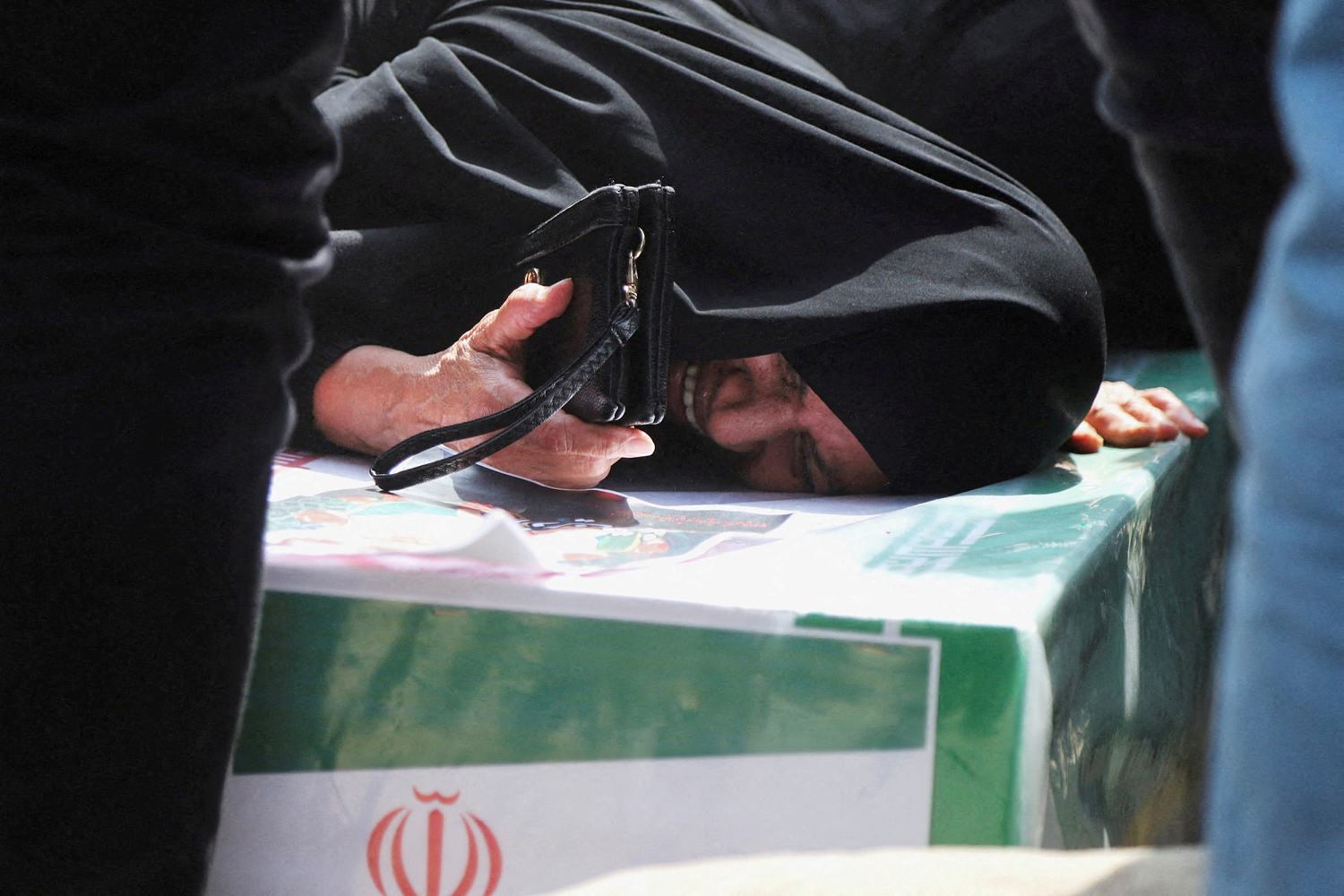
Witnesses speaking to NBC News described the horrific scenes in the aftermath of the strikes.
Monazah, whose son, Soheil, was killed in the attack just two days before his eighth birthday, said the school had “collapsed on top of the children” by the time she made it to the area.
“People were pulling out children’s arms and legs. People were pulling out severed heads,” she told NBC News on Monday.
Qasemi, the first responder, shared a similar account, telling NBC News “there were severed heads, severed hands, and bodies torn apart” as he described “extensive” rubble, with children “trapped underneath it.”
Amin Khodadadi reported from Tehran, Courtney Kube and Julie Tsirkin reported from Washington and Chantal Da Silva, Molly Hunter and Matthew Mullingan reported from London.