Pokémon Pokopia review: an expansive adventure disguised as a life sim
Nintendo has a history of fleshing out the larger Pokémon world through spinoffs. What games from the Pokémon Snap and Detective Pikachu series lacked in terms of action, they made up for in the way they made pokémon feel like creatures with rich lives outside of their relationships with trainers. And as the mainline series has evolved over the years, games like Legends: Z-A have begun putting more emphasis on the idea that pokémon might be better off if humans kept their distance.
Pokémon spinoffs have also tended to be relatively boxed-in, both in terms of how much space there is for you to play in and the way their stories are so self-contained. That wasn’t necessarily a bad thing, but it’s an aspect of these games that makes them feel small when you compare them to Pokémon Pokopia. In the new life sim, you can clearly see all of the cues co-developers The Pokémon Company, Game Freak, and Omega Force have taken from Animal Crossing, Minecraft, and Stardew Valley. But Pokopia makes its borrowed gameplay mechanics feel fresh by reimagining them through an inspired Pokémon lens.
Like most real-time games, Pokopia is a slow burn. The entire point is to meet new pokémon (instead of catching them) as you rebuild and beautify a ruined world. But as much emphasis as Pokopia puts on slowly cultivating friendships, the game gradually transforms into a sprawling adventure that you can customize however you want.
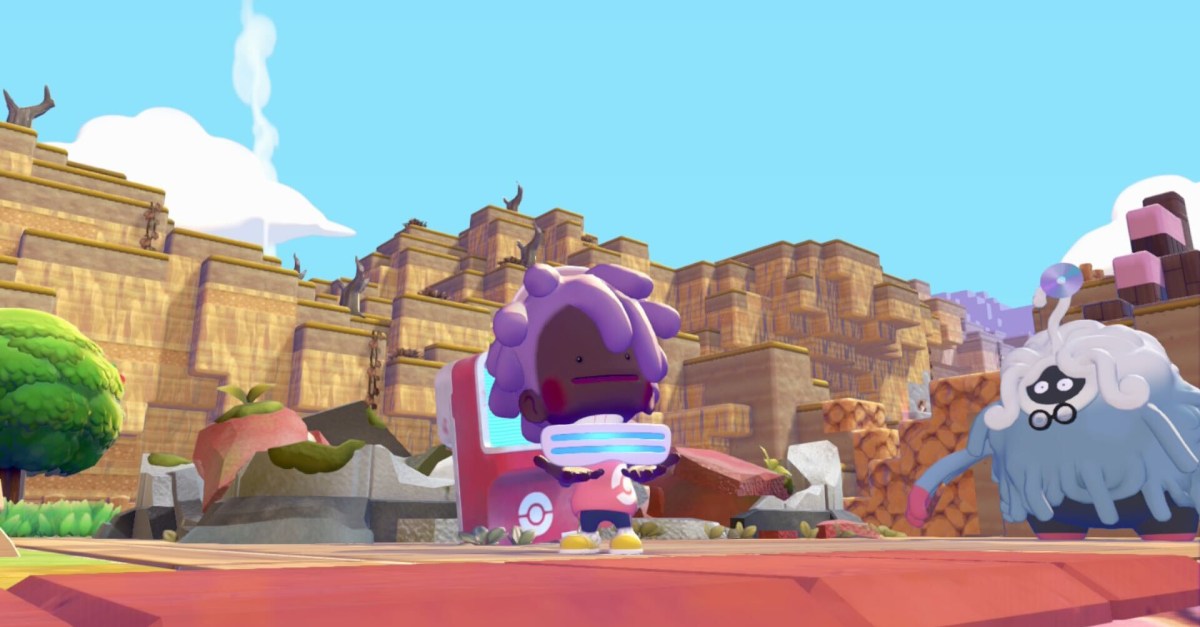
In Pokopia, you play as an unusual Ditto who gets separated from its human partner and wakes up alone in a world that initially seems devoid of other living beings. All your Ditto remembers is its trainer’s face — the game’s character customization options offer a variety of skin tones and hairstyles, but is initially limited in fashion — and it transforms into a duplicate of them because it feels lonely. Your Ditto’s trainer mimicry is convincing enough to get an old Pokédex’s face recognition working again, but what really surprises the gloopy monster is encountering an odd Tangrowth who thinks of itself as a kind of Professor and is downright shocked to meet a “human.”’
1/3Image: Nintendo, The Pokémon Company, Game Freak, and Omega Force
Unlike Animal Crossing: New Horizons, which gives you an almost entirely blank slate to work with, Pokopia drops you into a dilapidated but built-out world that’s in need of some serious restoration. When you enter the game’s first biome with Professor Tangrowth, it’s clear that the place used to be a cozy mountain town with roads, homes, and a Pokémon Center before it was all left in ruins by a mysterious disaster. You can see how the place could be rebuilt with a few carefully placed, cubical chunks of dirt, pavement, stone, and some flowers for color. But first, you and the good Professor have to tend to an ailing Squirtle who suddenly appears.
Imitating the dehydrated Squirtle and learning to wield its Water Gun attack is how your Ditto learns that it can use other pokémon’s abilities to change the terrain around it. Splashing Squirtle with a bit of water helps the monster get back on its feet, but using the move on the ground also encourages dead greenery to spring back to life. Your Ditto’s ability to beautify the world around it is what makes other pokémon want to become its friend, and in its first few hours of story, Pokopia challenges you to attract more new monsters to the once empty town, Viva Piñata-style, by creating a number of specific kinds of habitats.
Pokopia immediately puts you to work in order to give you a general understanding of how its luring, building, and mood mechanics work in tandem to progress the larger story. In order to rebuild important structures like the Pokémon Center and new houses, you need to recruit pokémon with specific specialties, like Bulldoze (used for demolition or relocation) and Chop (which is required for turning logs into workable lumber). But before you can recruit those pokémon, you have to build habitats they want to hang out in, like tall patches of grass shaded by trees or flowerbeds growing next to bodies of water. The more pokémon you meet, the more transformations and unique moves Ditto learns, and you have to be mindful of an upgradeable Power Point gauge that lets you know how many times Ditto can use an attack before it gets tired.
I got a little too caught up befriending pokémon at first because Pokopia’s writing gives each of the game’s monsters more personality than you typically see in a Pokémon title. Vespiquen has never been my cup of tea, but it was fun following one around as she gathered honey and commented on how tickled she was by my Ditto’s human getup. And as I spent more time completing tasks for my growing group of poké-pals, they took to calling Ditto “Doop” (the name I chose for it), and their moods about living in the biome became more positive.
1/4Image: Nintendo, The Pokémon Company, Game Freak, and Omega Force
The deeper I got into Pokopia, the more I found myself getting sidetracked because of how many different directions pokémon’s requests took me in and how much freedom the game gives you to just wander around. Once you’ve got an inventory full of materials and the right powers at your disposal, there isn’t much stopping you from going off and building whatever you can think of. Though each of Pokopia’s distinct biomes has boundaries that you can’t cross, the game’s maps are expansive and allow you to both dig deep into the planet and construct things high in the sky. So long as you build the right outdoor habitats, pokémon will continue to show up in them or agree to live there if you escort them.
Pokopia also lets you unlock certain biomes in whichever order you want, which is another thing that makes the game feel so flexible. While chatting with a colleague who’s also playing, we were both surprised to learn that we’d taken very different progression paths that had each introduced us to aspects of the game in slightly different orders.
Pokopia’s scale and the way it encourages you to travel between biomes gives you plenty to do, but it also makes it very easy to lose track of things. Early on, you learn a recipe to build expanded storage spaces for the things you’ve picked up, but don’t necessarily want to have on hand. But you have to remember where you place the boxes because the game doesn’t give you a way to easily locate them.
1/4Image: Nintendo, The Pokémon Company, Game Freak, and Omega Force
On more than one occasion, I knew I’d picked up a specific item a pokémon was asking for, but I couldn’t recall exactly where I’d left it. It’s also easy to lose track of your neighbors once you start renovating a biome’s green areas and infrastructure because the pokémon will wander off on their own when you haven’t asked them to follow you. This can be annoying when you need a specific monster to complete a construction project.
But part of Pokopia’s charm is seeing what kinds of shenanigans (like zipping around on train tracks) the pokémon get up to in their free time. It can feel overwhelming, but that stress is a tradeoff for the game’s openness. If New Horizons and The Legend of Zelda: Tears of the Kingdom have taught us anything, it’s that building-forward games like this can inspire people to construct all kinds of imaginative things. And with Nintendo holding the next mainline Pokémon’s launch until next year, folks are going to have plenty of time to let their imaginations run wild in Pokopia.
Pokémon Pokopia releases for the Nintendo Switch 2 on March 5th.